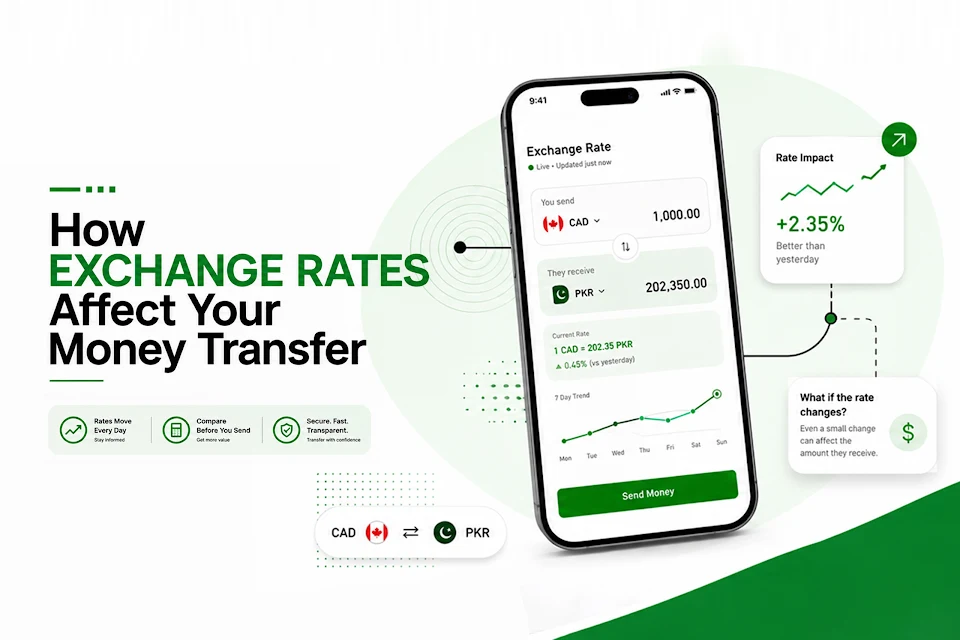
How Do Exchange Rates Work for International Money Transfers in Australia?
If you are sending money overseas from Australia, the exchange rate determines how much foreign currency your recipient receives for your Australian dollars.
For example, if you send Australian dollars to someone in another country, your money needs to be converted into the recipient's local currency. The rate used for that conversion is known as the exchange rate.
Exchange rates can change throughout the day, and the rate you see in the news may not be the same rate offered when you make an international money transfer. Transfer providers set the exchange rates they offer customers, and the final amount received can also depend on fees and any margin applied to the currency conversion.
Understanding how exchange rates work can help Australians compare international money transfers more effectively and know what to look for before sending money overseas.
Quick Answer: How Do Exchange Rates Work?
An exchange rate tells you how much one currency is worth in another currency.
For example, if the AUD/USD exchange rate is 0.70, AUD 1 is worth USD 0.70. If you exchange AUD 1,000 at that rate, the starting conversion would be USD 700 before considering any applicable fees or exchange rate margins.
The Reserve Bank of Australia defines an exchange rate as the price of one currency expressed in terms of another.
When sending money internationally, the exchange rate is therefore one of the main factors determining how much the recipient ultimately receives.
What Is an Exchange Rate?
An exchange rate represents the relative value of two currencies.
Currencies are usually shown as a pair. Some common examples for Australians include:
- ● AUD/USD for Australian dollars and US dollars
- ● AUD/GBP for Australian dollars and British pounds
- ● AUD/EUR for Australian dollars and euros
- ● AUD/NZD for Australian dollars and New Zealand dollars
If AUD/USD is quoted at 0.70, it means one Australian dollar can be exchanged for 70 US cents.
Exchange rates can also be shown in the opposite direction. This is why it is important to check which currency comes first when reading a rate.
How Does an Exchange Rate Work When Sending Money Overseas?
Suppose you are in Australia and want to send AUD 2,000 to someone overseas.
Your Australian dollars first need to be converted into the destination currency.
If the exchange rate available for the transfer is:
1 AUD = 0.65 USD
then:
AUD 2,000 × 0.65 = USD 1,300
Before any other applicable charges, the converted amount would be USD 1,300.
If the rate were instead:
1 AUD = 0.63 USD
the same AUD 2,000 would convert to:
USD 1,260
This simple example shows why the exchange rate matters when making an international transfer. Even a relatively small difference in the rate can change how much foreign currency is delivered.
Who Sets Exchange Rates in Australia?
Australia has a floating exchange rate.
This means the value of the Australian dollar is largely determined by supply and demand in global foreign exchange markets rather than being permanently fixed at a particular level.
Australia has operated with a floating exchange rate since 1983.
The Reserve Bank of Australia does not normally set a fixed value for the Australian dollar. Instead, the AUD moves as people, businesses, investors, governments and financial institutions buy and sell currencies around the world.
Why Do Exchange Rates Change?
Exchange rates can move constantly because currency markets respond to economic conditions, financial markets and expectations about the future.
Some factors that can influence the Australian dollar include:
- ● interest rates
- ● inflation
- ● economic growth
- ● global financial conditions
- ● commodity prices
- ● international trade
- ● investor demand
- ● market expectations
- ● economic or political news
The RBA explains that Australia's floating exchange rate is determined by demand for and supply of Australian dollars in the foreign exchange market.
This is why the AUD can be worth one amount in the morning and something slightly different later in the day.
What Does It Mean When the Australian Dollar Is Strong?
When the Australian dollar rises in value relative to another currency, it is called an appreciation.
For someone sending money overseas, a stronger Australian dollar generally means each AUD can buy more of the foreign currency.
For example:
At 1 AUD = 0.60 USD, AUD 1,000 converts to USD 600.
At 1 AUD = 0.70 USD, AUD 1,000 converts to USD 700.
In this simplified example, the stronger AUD means the recipient could receive more US dollars from the same amount of Australian dollars.
What Does It Mean When the Australian Dollar Is Weak?
When the Australian dollar falls in value relative to another currency, it is called a depreciation.
A weaker Australian dollar means each AUD buys less of the foreign currency.
Using the same example, if the exchange rate falls from 0.70 to 0.60 USD per AUD, AUD 1,000 would convert from USD 700 to USD 600 before fees or other charges.
This does not mean you should try to predict the currency market before every transfer. Exchange rates can be difficult to forecast, and even experienced market participants cannot consistently predict short-term currency movements.
Is the Exchange Rate Online the Rate You Actually Get?
Not always.
You may see an exchange rate on a financial website, search engine, news report or currency chart. This is often a market or reference rate.
The rate offered to an individual customer for an international money transfer can be different. Money transfer services and financial institutions may apply a margin to the exchange rate when converting currencies.
Australia's MoneySmart advises consumers to check whether the advertised rate is actually the rate they will receive and to consider both the currency exchange rate and transfer fees.
This is why comparing only the headline exchange rate may not tell you the complete cost of a transfer.
What Is an Exchange Rate Margin?
An exchange rate margin is the difference between a reference or market exchange rate and the rate offered to the customer.
For example, imagine the market rate is:
1 AUD = 0.6600 USD
and a transfer is offered at:
1 AUD = 0.6500 USD
The difference between those rates forms part of the currency conversion cost.
The ACCC notes that exchange rates can vary between suppliers and may include a margin or mark-up. It also warns that a service advertised as having no transfer fee is not automatically the cheapest option.
For this reason, Australians sending money overseas should consider the exchange rate and fees together.
What Is the Difference Between the Exchange Rate and Transfer Fees?
The exchange rate determines how one currency converts into another.
A transfer fee is a separate charge that may be applied for processing the international payment.
For example, you might send:
AUD 1,000
The provider may charge a transfer fee, apply an exchange rate for conversion, or use a combination of both.
Other costs can sometimes arise as well, including fees charged by intermediary or recipient banks depending on the type of transfer.
This means the cheapest-looking fee does not necessarily mean the recipient will receive the most money.
What Should You Compare Before Sending Money Overseas?
Instead of looking only at one number, consider the complete transfer.
Before confirming an international payment, check:
- ● the exchange rate offered
- ● the transfer fee
- ● the amount of foreign currency your recipient will receive
- ● whether additional bank charges may apply
- ● how long the quoted exchange rate remains available
- ● the expected delivery time
The ACCC recommends looking at the total price and the amount the recipient will receive when comparing international money transfer services.
For many customers, the final recipient amount is one of the easiest ways to understand the value of a transfer.
Can Exchange Rates Change While You Are Making a Transfer?
Yes.
Foreign exchange markets operate continuously across major global financial centres, so rates can change throughout the day.
Whether the rate changes after you begin a transfer depends on the provider and how the transaction works.
Some services may show you a rate that is available for a limited period. Others may determine the rate when the transaction reaches a particular processing stage.
Before confirming your transfer, check whether the displayed exchange rate is locked in and how long it remains valid.
What Is an Exchange Rate Guarantee?
An exchange rate guarantee means that an offered rate is held for a defined period or under specified conditions.
This can give you more certainty about how much foreign currency will be converted.
MoneySmart specifically recommends checking whether the exchange rate stays the same or can change when comparing international transfer services.
Always review the terms attached to a quoted rate, particularly if you are making a large transfer.
Does the Amount You Send Change the Exchange Rate?
It can.
Some providers may offer different exchange rates or pricing depending on the amount being transferred.
For example, the rate available for a small personal transfer may not always be identical to the rate available for a much larger transaction.
This is another reason to obtain a quote based on the exact amount you intend to send rather than relying on a general exchange rate displayed elsewhere.
Why Does the Recipient Amount Matter?
For most international transfers, the practical question is not simply, "What is the exchange rate?"
It is:
How much money will my recipient actually receive?
Two transfer options could advertise different fees and exchange rates, but the one with the lowest stated fee may not necessarily deliver the highest amount.
Looking at the final recipient amount helps combine the effect of the exchange rate and transfer costs into one easier comparison.
How Can Australians Check an Exchange Rate Before Sending Money?
Before transferring money overseas, you can compare the quoted rate with a general market reference to understand the difference.
However, a market reference rate should be used as a comparison point rather than an assumption about the exact rate you will receive.
The RBA publishes exchange rate information, but it notes that its published rates are indications of market value and may differ from rates quoted by foreign exchange dealers and other market sources.
The most important figure for your actual transfer is the rate displayed by your chosen service before you confirm the transaction.
Frequently Asked Questions
What is an exchange rate in simple terms?
An exchange rate tells you how much one currency is worth when converted into another currency. For example, it can show how many US dollars, British pounds or euros you receive for each Australian dollar.
Why is the exchange rate different between money transfer services?
Different providers can set different retail exchange rates and apply different margins, fees and pricing structures. This means the same amount of Australian dollars may result in different recipient amounts.
Do exchange rates change every day?
Yes. Exchange rates can change throughout the day as currencies are traded in global markets.
Is a higher exchange rate always better?
When the rate is quoted as the amount of foreign currency received for AUD 1, a higher rate generally means you receive more of that foreign currency. However, you should still check any transfer fees and the final recipient amount.
Is the Google or news exchange rate the rate I will receive?
Not necessarily. Rates shown online are often reference or market rates. The retail exchange rate offered for your international money transfer may be different.
What exchange rate should I check before sending money from Australia?
Check the actual exchange rate quoted by your transfer service for the amount and destination you are sending to. You can compare it with a reference rate, but the quoted customer rate is the one that matters for your transaction.
What is AUD in an international money transfer?
AUD is the international currency code for the Australian dollar. When you send money from Australia to another country, your AUD may be converted into the recipient's local currency.
Final Thoughts
Exchange rates are a central part of every international money transfer involving different currencies.
For Australians sending money overseas, the exchange rate determines how much foreign currency your Australian dollars can buy. Because rates can move and providers may offer different retail rates, it is important to check the actual exchange rate, any applicable fees, and the final amount your recipient is expected to receive before confirming a transfer.
Understanding these basics makes it easier to compare your options and know where your money is going.
When you are ready to send money overseas, Remit5 provides a safe, secure and convenient international money transfer service for customers in Australia, helping make international payments simple, transparent and reliable.