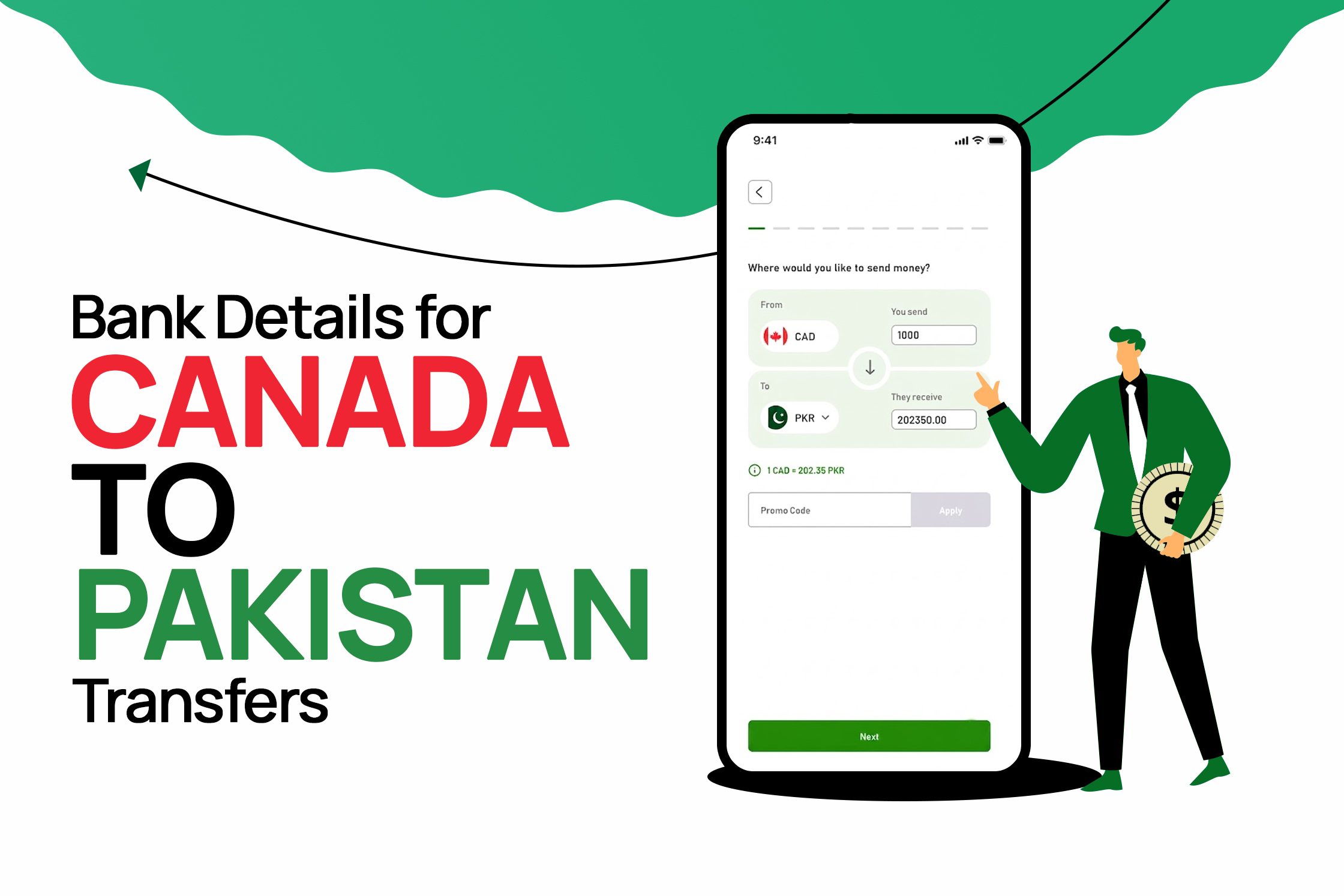
What Bank Details Are Needed to Send Money from Canada to Pakistan?
Sending money from Canada to Pakistan is usually simple, but only when you have the right information.
Whether you are helping family, paying education expenses, covering medical costs, or sending money to your own account, the transfer can be delayed if even one banking detail is incorrect.
A small spelling mistake in the recipient's name or one wrong number in the IBAN may be enough to stop the payment.
That is why it is always a good idea to collect the recipient's details before you begin.
In this guide, we explain what bank information you normally need to send money from Canada to Pakistan and what you should check before confirming the transfer.
What Details Do You Usually Need?
The exact information may vary depending on the bank or money transfer company you use. In most cases, you will need:
- ● The recipient's full name
- ● Their Pakistani IBAN or bank account number
- ● The name of their bank
- ● Branch details, if requested
- ● A SWIFT or BIC code for some bank wires
- ● The recipient's address and mobile number
- ● The reason for sending the money
- ● Your relationship with the recipient
Some online money transfer services ask for only the basic details, while a traditional international bank wire may require more information.
Make Sure the Recipient's Name Is Correct
The recipient's name should be entered exactly as it appears on their bank account.
Avoid using a nickname, initials, or a shorter version of the name. For example, if the account is registered under "Muhammad Ahmed Khan," entering "Ahmed Khan" may cause a mismatch.
The easiest way to avoid this problem is to ask the recipient to copy their account title from an official source, such as a bank statement, cheque book, account certificate, online banking profile, or mobile banking app.
It may seem like a small detail, but name mismatches are a common reason for delayed transfers.
You Will Usually Need a Pakistani IBAN
The IBAN is one of the most important pieces of information when sending money to a bank account in Pakistan.
IBAN stands for International Bank Account Number. It is used to identify the recipient's bank account during local and international payments.
A Pakistani IBAN normally begins with "PK" and contains 24 characters.
The recipient can usually find it in:
- ● Their banking app
- ● Online banking
- ● A bank statement
- ● A cheque book
- ● An account certificate
Ask the recipient to send the IBAN in writing rather than reading it over the phone. This lowers the chance of entering the wrong letter or number.
You should never try to guess or create an IBAN yourself. Even one incorrect character can cause the transfer to fail or be returned.
Some money transfer providers may ask for a local account number instead of an IBAN. In that case, simply follow the instructions shown during the transfer.
Bank Name, Branch Details, and SWIFT Code
You will also need the full name of the recipient's bank.
When selecting a bank from a list, take a moment to make sure you choose the correct one.
Some bank names and abbreviations can look similar.
Depending on the transfer service, you may also be asked for:
- ● Branch name
- ● Branch code
- ● Branch city
- ● Branch address
The recipient can normally find this information on a bank statement, cheque, account document, or banking app.
A SWIFT code, sometimes called a BIC, may also be required. This code identifies the recipient's bank within the international banking network.
SWIFT codes are more commonly needed when sending money directly from a Canadian bank through an international wire transfer. Some online remittance services do not ask for one because they use local banking partners in Pakistan.
When a SWIFT code is required, ask the recipient to confirm it with their bank. Avoid relying on random websites, as an incorrect code could send the payment to the wrong banking route.
Address, Phone Number, and Transfer Purpose
Many transfer providers also ask for the recipient's home address and mobile number.
These details may be used for identity checks, transfer updates, or communication from the receiving bank. Make sure the phone number is active, and the address is current.
You may also be asked why you are sending the money.
Common reasons include:
- ● Family support
- ● Education expenses
- ● Medical treatment
- ● Household costs
- ● Gifts
- ● Personal savings
- ● Donations
- ● Payment for goods or services
Choose the option that best matches the real reason for the transfer.
The provider may also ask about your relationship with the recipient. For example, you may need to select parent, spouse, sibling, friend, customer, supplier, or self.
These questions are a normal part of the transfer process and help banks and money transfer companies meet financial regulations.
What Information Will You Need to Provide in Canada?
The sender also needs to provide personal and payment information.
You may be asked for:
- ● Your full legal name
- ● Your Canadian home address
- ● Your date of birth
- ● Your phone number and email
- ● Your occupation
- ● Government-issued photo identification
- ● Your bank account or card details
- ● The source of the money
- ● The reason for the transfer
For larger transfers, the provider may ask for additional documents, such as a bank statement, payslip, or proof of income.
This does not necessarily mean there is a problem. Identity and source-of-funds checks are common when using a regulated money transfer service.
Check the Total Cost Before You Send
It is easy to focus only on the transfer fee, but the fee is not the only cost.
The exchange rate also affects how much money the recipient receives in Pakistani rupees. A company may advertise a low fee but offer a weaker CAD-to-PKR exchange rate.
Before choosing a provider, compare:
- ● The transfer fee
- ● The exchange rate
- ● Any exchange-rate markup
- ● The delivery time
- ● Possible receiving-bank charges
- ● The final amount the recipient will receive
The final amount in Pakistani rupees is often the best way to compare different services.
Double-Check Everything
Before confirming your payment, review every detail carefully.
Make sure the recipient's name matches the bank account, the IBAN begins with "PK," the bank name is correct, and the mobile number is active.
You should also be careful if someone suddenly sends you new bank details through email, text, or social media. Confirm the information with the recipient directly before sending any money.
A few extra minutes of checking can save you from a long delay or a failed transfer.
Final Thoughts
To send money from Canada to a bank account in Pakistan, you will usually need the recipient's full account title, Pakistani IBAN or account number, bank name, and any branch or SWIFT details requested by the transfer provider. You may also need their address, phone number, transfer purpose, and relationship information.
Before confirming the transfer, double-check every detail and compare the fees, exchange rate, delivery time, and final amount the recipient will receive. When you are ready to send money from Canada to Pakistan, Remit5 can help make the process simple, clear, and convenient.